
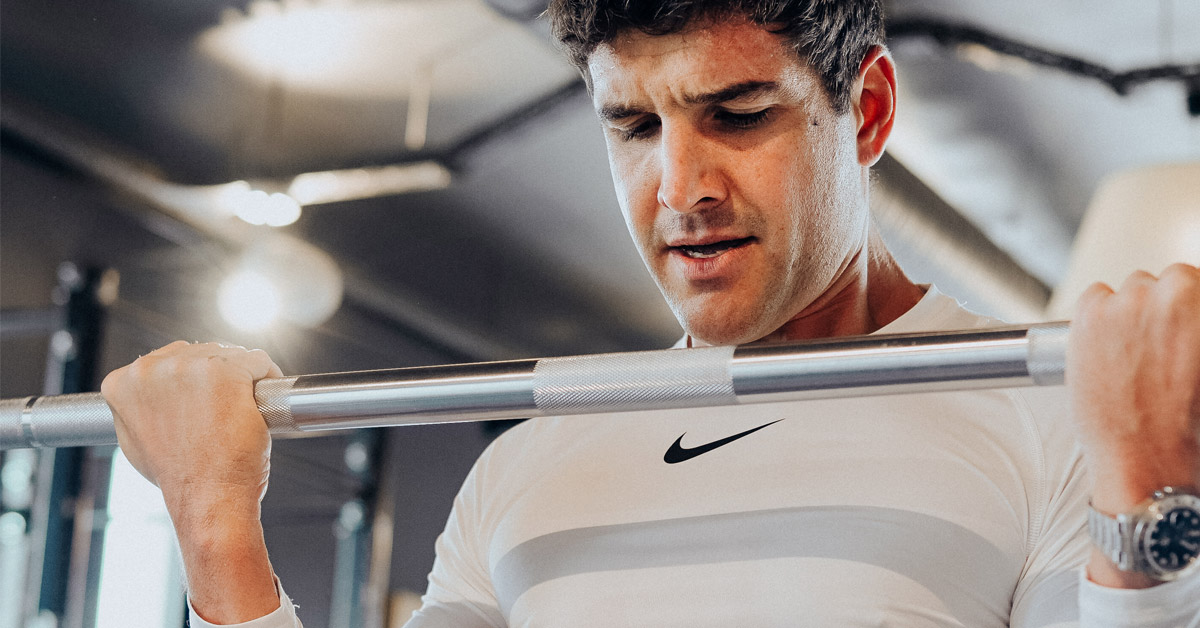
Especially with the male sports enthusiasts the large (upper) arm circumference is in great demand. Even women often enviously look on the tight and well-formed arms of younger comrades and sports celebrities. In the following, the topic of arm training in the sense of hypertrophy, muscle building training, will be discussed. According to the biology of the body, the training also serves to build up strength. An important factor for the Evo visitor, who is looking for a better quality of movement in pull and push movements. So the visitor can, for example, learn the pull-up, chin-up or even a more complex exercise such as muscle up or perform better in it. These exercises require to over-wind your own body weight. In order to better understand the meaning of the exercises selected here, the topics exercise selection and hypertrophy mechanism are first explained and the exercises derived from them.
If you want to build strength, the exercise should match the movement of the sport, so devices almost always fall away. When building muscle, the exercise is determined by which area of the target muscle to hypertrophy: approach, origin, different muscle heads or fiber profiles. In principle, the limiting structure is most intensively trained in all exercises. This limiting factor should be found. If the exercise deadlift must be terminated due to a too weak grip, all other structures involved are not trained optimally. Exercises on unstable surfaces but also with unstable objects as resistance are always to be avoided for hypertrophy and strength goals – balance is the limiting factor here and prevents hypertrophy or force adaptation.
Furthermore, the training level of each trainee should be taken into account. The exercise selection for a beginner starts with coordinatively simpler exercises (e.g. Goblet before Back Squat). Restrictions or injuries also play an important role. They reduce the exercise selection. In tendonitis, exercises that have a high resistance (load curve) in the maximum extension position are eliminated (Spider Curl instead of Scott Curl or chin-up). The existing mobility and control also determines which exercises are suitable. Another serious factor is the “Risk to Benefit Ratio”: Exercises that lead to high joint and / or connective tissue loads, but provide little muscular stimulus, are more to be treated with caution. These include exercises in which a pushing movement is carried out “behind” the frontal plane (back); e.g. Dips and Neck Press. Also not to be neglected is the aspect of time: One training session per week selects exercises that stress as many muscles or muscle fibers as possible at the same time. Single joint exercises fall away. With daily training exercises of the past and the coming day have to take into account. The equipment available also determines which exercises are suitable.
Hypertrophie Mechanisms:
Furthermore the hypertrophy mechanism determines which exercise is chosen. For a high metabolic burden and for many repetitions, e.g. an exercise with a load curve adapted to the power curve is selected. For maximum muscular microtrauma, a large load at the eccentric reversal point is important. Maximum tension is achieved by basic exercises.
A distinction must still be made between approach-related and origin-related hypertrophy. The Guideline for Approach and Origin-Related Hypertrophy:
- Maximum tension (load) at peak contraction (maximum shortening) -> origin
- Maximum tension (stress at maximum stretch) -> approach
A muscle growth stimulus can be triggered via 3 mechanisms. Depending on which mechanism is to be addressed, different exercises are available:
- Metabolic stress: Constant muscle contraction at a minimum intensity of 60% Fmax and a TUT (time under tension) of 40-90 seconds (equivalent to approximately 15-30rep.) is necessary. Exercises without lockout or a continuous resistance curve are the first choice. Slow type I muscle fibers are trained.
- Microtrauma: A maximum elongation of the target musculature with simultaneous large resistance at the eccentric reversal point (predicament) is required. The optimal intensity is 70-85% of the maximum force. A load duration of 12-40 seconds makes sense. This is the most effective hypertrophy mechanism. These exercises are considered to have the greatest potential for hypertrophy. Medium-fast type IIa muscle fibers are the most stimulated.
- Mechanical stress: Maximum load generates a large activity of the mechano-chemical sensors – resulting in protein synthesis. The intensity should be above 85% Fmax. This results in a short time under tension of 1-12 seconds. Basic exercises are to be favored here. Fast type IIb muscle fibers are trained.
Arm extension:
- Origin close: Lay on back and arms laterally, just beside the body. Press palms / arms into the floor. Pulling the knee to the chest: Small as a ball (hip and knee flexion). Roll slowly up, lift your hips. And roll back slowly, lower hip, just before completely dropping, back up.
- Approach close: Plank (on forearms) to hand plank by straighten the elbows. Hands or elbows are under the shoulder.
Arm flexion:
- Approach close: Chin-up
- Origin close: Jesus (Cable Cross) Curls
Be First to Comment